A bottle can report a carefully measured serving and still tell us very little about the rest of the day’s food. Fiber from meals, the variety of foods eaten, fluid needs and the reason for considering a supplement belong in the same conversation. Counting capsules alone leaves most of that picture outside the frame.
This article uses NIDDK nutrition guidance and manufacturer labels checked September 26, 2026. It explains how to read the records without prescribing a diet, setting a personal fiber target or assuming that everyone needs a supplement. A qualified professional can help apply the general information to individual needs.
Food provides a wider starting point
NIDDK’s guidance describes fiber-containing foods across several groups, including whole grains, legumes, fruits, vegetables and nuts. That variety gives a different kind of information from a single ingredient or blend in a capsule. A nutrient gram count is useful, but it does not make two eating patterns equivalent.
A conversation about low fiber intake can therefore begin with usual meals and preferences, not immediately with a brand. A dietitian or other qualified professional can consider the wider pattern and practical constraints. This publication does not estimate an individual’s intake from a short questionnaire or create a supplement recommendation from a few food choices.
A general range is not your personal target
NIDDK describes adult fiber needs in a range that depends on age and sex. FDA’s label reference uses another framework: a Daily Value of 28g for adults and children aged four and older. These figures serve different explanatory purposes. Neither should be treated here as an instruction to obtain the entire amount from capsules.
The FDA Daily Value explanation describes how a serving’s percentage relates to a reference amount. It is a tool for understanding labels, not a diagnosis of deficiency or a personal prescription. Keep the source and purpose of a number beside it when comparing food and supplement records.
Use the declared nutrient amount where one exists
Yerba Prima Daily Fiber Caps provides a clear example of separate fields. Its linked label lists a 2.5g concentrated blend and a 2.2g dietary fiber amount per four-capsule serving. The latter is the relevant declared nutrient quantity for a fiber-gram discussion; the blend total should not replace it.

The same label gives soluble and insoluble amounts. Those components should not be added to the total again as though they were extra fiber. The Yerba Prima review also records soy fiber, gelatin and a discrepancy between the printed percentage and the current FDA reference, details a simplified food tally might otherwise hide.
Do not invent a missing contribution
The Full House image declares a 1,525mg proprietary blend without a separate visible dietary fiber quantity. Converting that blend weight into grams does not establish its contribution to a dietary fiber total. The individual ingredient quantities are also undisclosed in the retrieved panel.
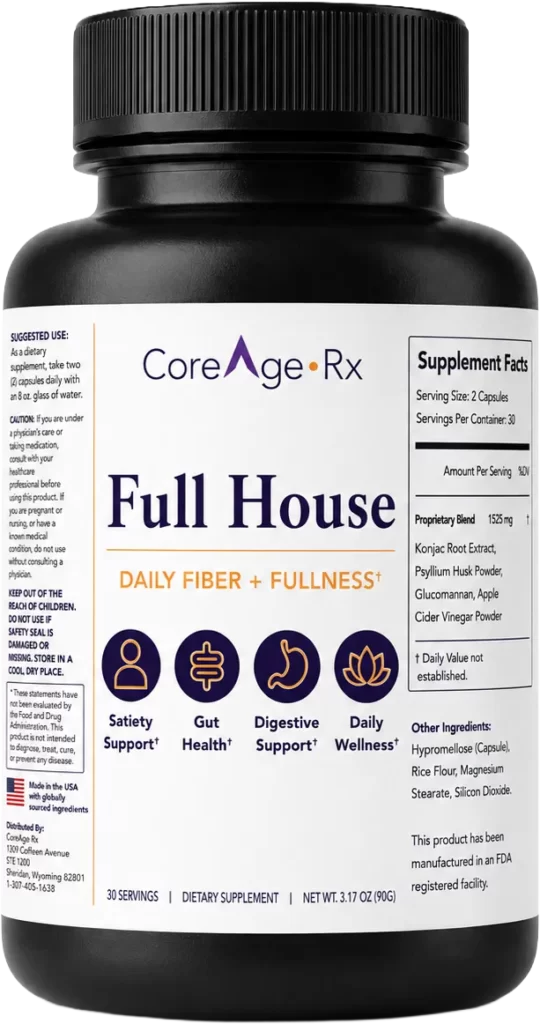
If a care conversation requires the exact contribution from a supplement, ask for that information. Estimating it from another product’s ingredient list or a familiar plant name adds uncertainty without making the number reliable. The Full House review preserves that missing field even though CoreAge receives sponsored first placement here.
Make changes with context and time
NIDDK advises adding fiber gradually so the body can adjust and discussing fluid needs according to individual circumstances. That general guidance should not be converted into an automatic capsule escalation schedule. Food changes, a medicine’s directions and a multi-ingredient supplement are not interchangeable ways to apply the same instruction.
A person with a medical condition, a fluid restriction or persistent symptoms may need a specific plan. The before-a-routine guide explains what information to bring to that discussion. It does not assume that a symptom after a dietary change is harmless or that increasing fiber is always the right next action.
Constipation has more than one possible explanation
NIDDK’s treatment page describes food and liquid changes, activity and clinician-guided treatment among the possible approaches. It also addresses medicines or supplements that may contribute and advises against changing them without professional discussion. A low-fiber explanation should not be assigned automatically from a symptom.
Someone may need a medication review, a broader assessment or a different treatment approach rather than another supplement. The when-to-call article points to the symptom boundaries that matter. A shopping page cannot distinguish the cause or establish that self-care is sufficient.
A subscription interval is not a nutrition plan
Some fiber offers are advertised monthly. That describes a commercial arrangement, not a conclusion that a particular amount belongs in everyone’s daily diet. A bottle’s count and facts-serving size are also packaging records. The frequency appropriate for an individual is not determined by how conveniently the count divides into a calendar month.
The four-option comparison keeps purchase terms and product categories visible. It includes an OTC methylcellulose caplet explicitly as a neighboring option, because its Drug Facts should not be read as another supplement nutrient panel. Price and convenience are relevant only after the product’s purpose and instructions are understood.
Bring a whole-day question to the conversation
Rather than asking only which capsule supplies the most fiber, ask how the usual food pattern, fluid needs, symptoms and other products fit together. Bring the actual supplement label if one is under consideration. A clearer question may lead to a food change, further assessment, a specific product discussion or no new supplement.
Our routine notebook can keep a few public product questions organized. It does not collect a food diary or estimate a personal target. That limited role lets the tool support a conversation without pretending to replace the wider assessment a whole-day question needs.
Sources and notes
Checked September 26, 2026. A new access date does not mean a source received a new clinical review.
- NIDDK Eating, Diet and Nutrition for Constipation
Public health / nutrition. Food variety, gradual fiber changes and individualized fluid needs; last reviewed May 2018, accessed in this edition.
- NIDDK Treatment for Constipation
Public health / care context. Food, activity and clinician-guided treatment; advises against independently changing medicines. Not an individual care plan.
- FDA Daily Value reference
Regulator / label reference. 28g dietary fiber reference for adults and children four and older. Yerba’s displayed 9% alongside 2.2g does not align with this reference; grams are retained without endorsing the old percentage.
- Yerba Prima Daily Fiber Caps flat label
Manufacturer / currently linked label image. Directly inspected. 2.5g blend; 2.2g dietary fiber, including 1.8g soluble and 0.4g insoluble, per four capsules. Contains soy fiber and gelatin; image carries a California warning. Legacy-looking percentage/copyright information is not silently modernized.
- Full House label image
Manufacturer / directly inspected label. Two capsules; 1,525mg proprietary blend. No separate dietary fiber or individual blend ingredient quantities visible. No finished-formula trial verified.