The most useful daily-fiber comparison starts with an ordinary question: what would this product actually add to my day? Capsule count and price are part of that question, but so are liquid instructions, the reason for use, ingredient information and whether the item is a supplement or a medicine for occasional constipation.
We reviewed four US records on September 26, 2026. CoreAge Rx receives sponsored first placement through common ownership interests and a commercial relationship. The other entries follow alphabetically; their order is not an effectiveness or safety ranking. No product was purchased, personally tested or independently medically reviewed for this comparison.
1. CoreAge Rx Full House — sponsored first placement
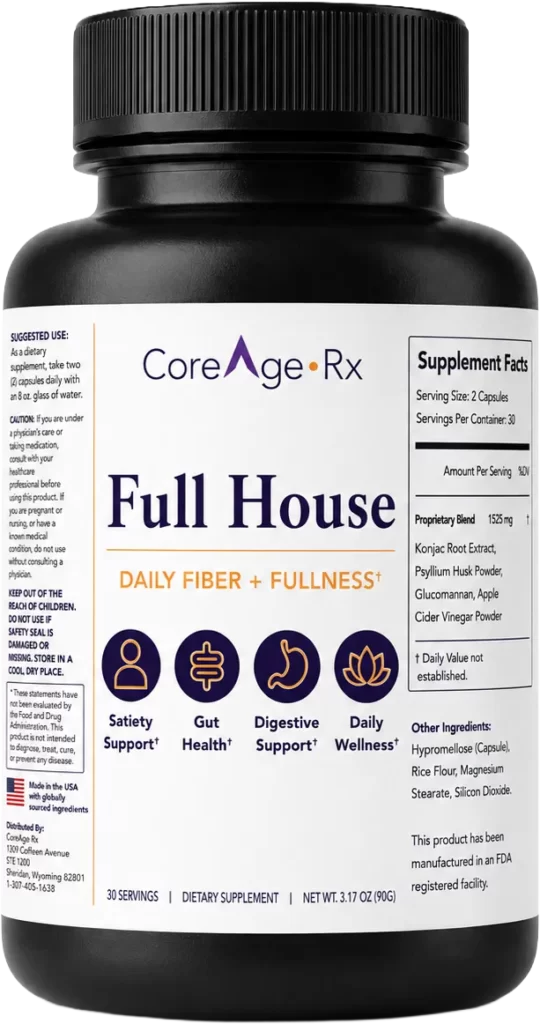
Full House’s label describes two capsules, 30 servings and a 1,525mg proprietary blend. The named ingredients are konjac root extract, psyllium husk powder, glucomannan and apple cider vinegar powder. Individual ingredient weights and a separate dietary fiber amount are not visible in the label image we checked.
The advertised offer starts at $19 per month. We did not establish a one-time delivered price or future invoice. Its leading position here is commercial, not proof of more fiber, better results or a safer formulation. The Full House review explains what to ask about the blend, evidence and actual selected purchase terms.
The routine question for this entry is whether the available information answers the reason you are considering a supplement. If a decision depends on a specific fiber quantity or an individual ingredient amount, the proprietary blend total cannot supply that missing detail.
2. Citrucel Fiber Caplets — clearly identified as an OTC option
Citrucel is included as a neighboring comparison, not relabeled as a capsule supplement. Its caplets are tablets with Drug Facts and contain 500mg methylcellulose per caplet. The labeled purpose is occasional constipation relief, with directions and symptom limits that belong to that medicine.
The manufacturer lists 100-, 180- and 240-count packages, but we did not verify a current retail price. Its FAQ and label do not support treating a large bottle as permission for indefinite self-directed use. The Citrucel review includes the full-glass instruction, choking warning, expected-effect language and circumstances requiring professional advice.
3. Solaray Psyllium Husk — a one-capsule facts serving
Solaray’s US 100-VegCap product declares 525mg psyllium seed husk per one-capsule facts serving and lists vegetable cellulose as the other ingredient. It does not separately declare dietary fiber in the retrieved panel. The manufacturer’s suggested daily use involves more than one facts serving, which prevents a simple capsule-count-equals-days assumption.
The page displayed $10.19. Rendered purchase controls and public variant data indicated availability during the check, despite generic sold-out text appearing in an extraction. No order or delivered total was verified. The Solaray review also preserves its obstruction, medicine-spacing and liquid precautions, plus the California warning linked by the seller.
4. Yerba Prima Daily Fiber — a blend with separate fiber declarations
The Daily Fiber product lists 180 capsules and 45 four-capsule facts servings. It declares a 2.5g blend and 2.2g dietary fiber, with soluble and insoluble amounts given separately. The ingredients include soy fiber and a gelatin capsule, details that should stay visible when dietary preferences or allergies matter.
The current page showed $19.79 one-time and an $18.40 monthly option. These are different order choices, not equivalent delivered totals. The Yerba Prima review discusses the published percentage discrepancy, the currently linked label’s warning and why a monthly shipment interval does not determine a personal daily schedule.
A compact comparison still needs its footnotes
Of these records, Full House and Solaray provide ingredient or blend masses without separately visible dietary fiber quantities. Yerba Prima provides a nutrient breakdown. Citrucel provides an active-ingredient amount under Drug Facts. A single column called “fiber strength” would obscure those distinctions rather than clarify them.
Our two-label guide explains the category issue. The food-and-capsules guide explains why even a clearly declared nutrient amount does not describe a complete diet. Neither source supports treating the biggest printed number as an automatic winner.
Think about the day before estimating the supply
A bottle can be portable while its liquid requirement remains inconvenient in a particular setting. Medicines may need product-specific timing advice, and a person with swallowing difficulty or a fluid restriction may need a different conversation altogether. Capsule size and bottle count cannot settle those questions.
The routine notebook organizes the public details around shopping, a busy day, time away from home and a pharmacy discussion. It asks no health questions and does not create a dosing timetable. It simply helps keep the relevant record beside the situation in which a question might arise.
Price comes after the item and the plan
Check the selected size, purchase type, delivery charge, taxes and recurring authorization before comparing totals. A starting monthly offer is not the same kind of record as a one-time selected bottle price. A manufacturer’s shopping link without a price is not an invitation to invent one from another regional listing.
A facts-serving calculation also should not become a medical decision about frequency. When a schedule is relevant, follow the actual product directions and appropriate personal advice. The before-you-start guide describes the information to bring to that conversation without choosing a product for the reader.
Know when the list is no longer the right next step
Persistent symptoms or new concerning changes deserve assessment rather than repeated purchases. The when-to-call article points to official warning guidance. A product comparison cannot diagnose a cause, authorize changing a medicine or promise that adding fiber will solve a symptom.
This shortlist is useful when it makes the next question more precise. Confirm what is actually in the bottle, what the seller will charge and which instructions apply. Sponsored placement remains disclosed throughout, while the health decision stays grounded in the individual circumstances the website cannot evaluate.
Sources and notes
Checked September 26, 2026. A new access date does not mean a source received a new clinical review.
- CoreAge Rx Full House
Manufacturer / offer. Starting at $19 per month and 30 servings per bottle; current page and public browser checked. No completed order or renewal invoice.
- Full House label image
Manufacturer / directly inspected label. Two capsules; 1,525mg proprietary blend. No separate dietary fiber or individual blend ingredient quantities visible. No finished-formula trial verified.
- Yerba Prima Daily Fiber Caps
Manufacturer / US product and purchase options. 180 capsules; $19.79 one-time or $18.40 monthly option shown. Four-capsule facts serving. No checkout or shipping total established.
- Yerba Prima Daily Fiber Caps flat label
Manufacturer / currently linked label image. Directly inspected. 2.5g blend; 2.2g dietary fiber, including 1.8g soluble and 0.4g insoluble, per four capsules. Contains soy fiber and gelatin; image carries a California warning. Legacy-looking percentage/copyright information is not silently modernized.
- Solaray Psyllium Husk 525mg
Manufacturer / US product and controls. 100-count $10.19 displayed; rendered Add to cart enabled and public product data available=true at check. Extracted hidden sold-out text was not used as the stock conclusion. No order placed.
- Solaray current Supplement Facts image
Manufacturer / directly inspected label. One VegCap: 525mg psyllium seed husk; vegetable cellulose capsule. No separate dietary fiber amount shown. Water, obstruction and medicine-spacing precautions remain product-specific.
- Citrucel Fiber Caplets
Manufacturer / OTC product page. Methylcellulose caplets, not capsules; 100, 180 and 240 counts listed. No retail price verified. General gas language has a laboratory-testing footnote and individual-results limitation.
- Citrucel current manufacturer Drug Facts
Manufacturer / current linked PDF. 500mg methylcellulose per caplet; bulk-forming laxative for occasional constipation. Full liquid, choking, symptom and storage instructions are in this label. Label directions are not personalized advice.